
The Humility Factor: What Separates Excellence from Arrogance
Insights from the the US Government Agency with the Most Excellence...and Arrogance

When we look closely at arrogance in academic research, we find it's typically studied alongside narcissism rather than as its own phenomenon. The characteristics associated with arrogance mirror those of narcissistic personality disorder: exaggerating one's talents, lacking empathy, and expecting recognition of one's superiority.
Meanwhile, excellence has a distinct meaning—it's about achieving truly high quality (Excellence Definition & Meaning | Britannica Dictionary). The word itself comes from a root meaning "above" or "higher," which also connects it to ideas of status and rank (Excellency Definition & Meaning | Britannica Dictionary).
While both arrogance and excellence involve superiority, there is a crucial difference: excellence reflects actual superior performance, while arrogance manifests as an inflated sense of superiority coupled with a lack of empathy. In other words, excellence is about being good; arrogance is about thinking you're good while dismissing others and your own limitations.
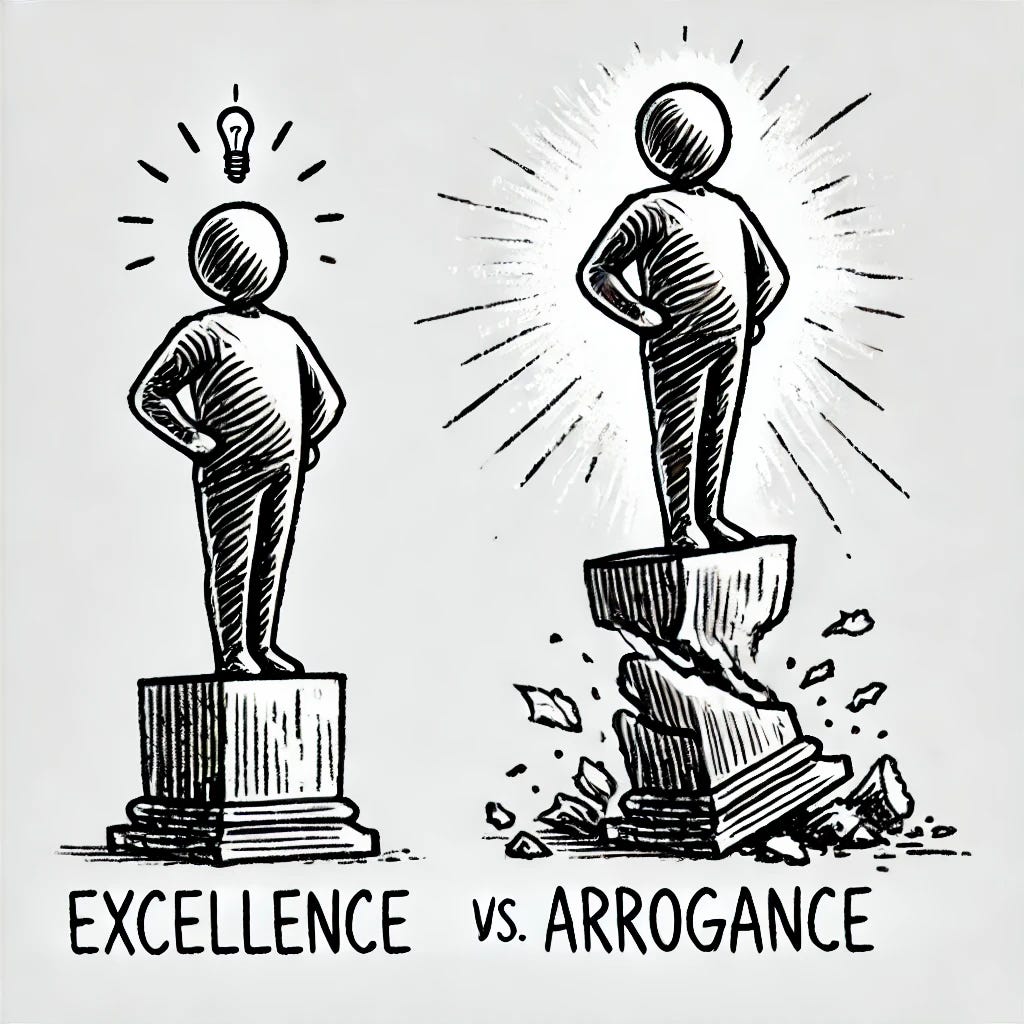
During my research interviewing CIA officers about ethical leadership, a tension emerged around excellence, humility, and arrogance. Here's what I discovered about this complex dynamic and why it matters for leaders everywhere.
The CIA officially defines excellence as bringing "the best of our diverse backgrounds and expertise to everything we do" while remaining "self-aware, reflecting on our performance and learning from it." Sounds great on paper. My interviews revealed something more complicated happening on the ground.
The Excellence-Arrogance Trap
Intelligence officers operate in an environment of extreme pressure where excellence isn't just encouraged - it's mission-critical. But here's the catch: that same pressure that drives excellence can also breed arrogance. When leaders are constantly making high-stakes decisions under intense stress, maintaining humility becomes challenging.
One analyst echoed the feeling that no matter what the pressure or circumstances, how you treated people had to have a baseline of respect:
Especially at a time when we were under tremendous pressure from Congress to find out a lot of unknowns. You can't curse at people and bully people just for the heck of it, just because you can, or because you think people are not worthy of your standard.
Another officer noted that treating people poorly under pressure ultimately weakened the person’s motivation and weakened the mission:
I was not a screamer. I did not throw things. I did not humiliate people. I did not call them names. I did not. Those were things that were done to me by managers. I never liked it and I never thought it was an effective management tool.
From his judgement, supported by evidence in research, the tactics of humiliation not only were degrading, but did not improve performance.
The Mental Energy Factor
Maintaining humility requires mental energy - energy that gets depleted by the exact conditions CIA officers face daily: stress, constant decision-making, and intense mission focus. As one researcher put it, self-control (which helps people treat others with respect during stress) is a limited resource.
Ethical leadership research shows that self-control operates like a battery that can be drained. This is particularly relevant for intelligence officers, who face multiple factors that deplete this mental energy:
Constant high-stakes decision-making
Intense operational stress
Sustained mission focus
Complex problem-solving demands
The Leadership Lesson
Here's what makes this relevant beyond intelligence work: Any high-performing organization risks sliding from excellence into arrogance. The antidote? Humility - specifically, the ability to take others' perspectives and maintain an accurate self-image (explore your shortcomings).
When leaders lose their humility reserves, they risk:
Treating subordinates poorly (which results in disengagement from problem solving and reduces creativity).
Missing opportunities for learning (dismissing lessons that can lead to improved results).
Damaging team dynamics (team members withdraw and become less engaged, difficult for teams to handle conflicts constructively or adapt to new challenges).
The Way Forward
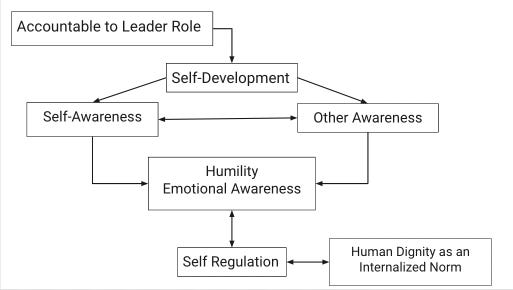
My research revealed a clear path to increasing humility. It begins with accepting accountability as a leader. Once that accountability is acknowledged, it brings a responsibility for personal development. This commitment to self-development is activated through mentorship, coaching, or assessments that deepen emotional understanding and empathy for both oneself and others. Engaging in this process fosters humility rather than arrogance. As one’s capacity for emotional awareness and self-regulation increases, humility becomes a foundation for ensuring that others are treated with dignity.
The key insight for leaders: Excellence without humility becomes arrogance. True excellence requires both superior performance AND the humility to keep learning, take other perspectives, and treat people with dignity - even under pressure.
What are your thoughts on balancing excellence and humility in leadership? Have you seen examples of this tension in your own work?